
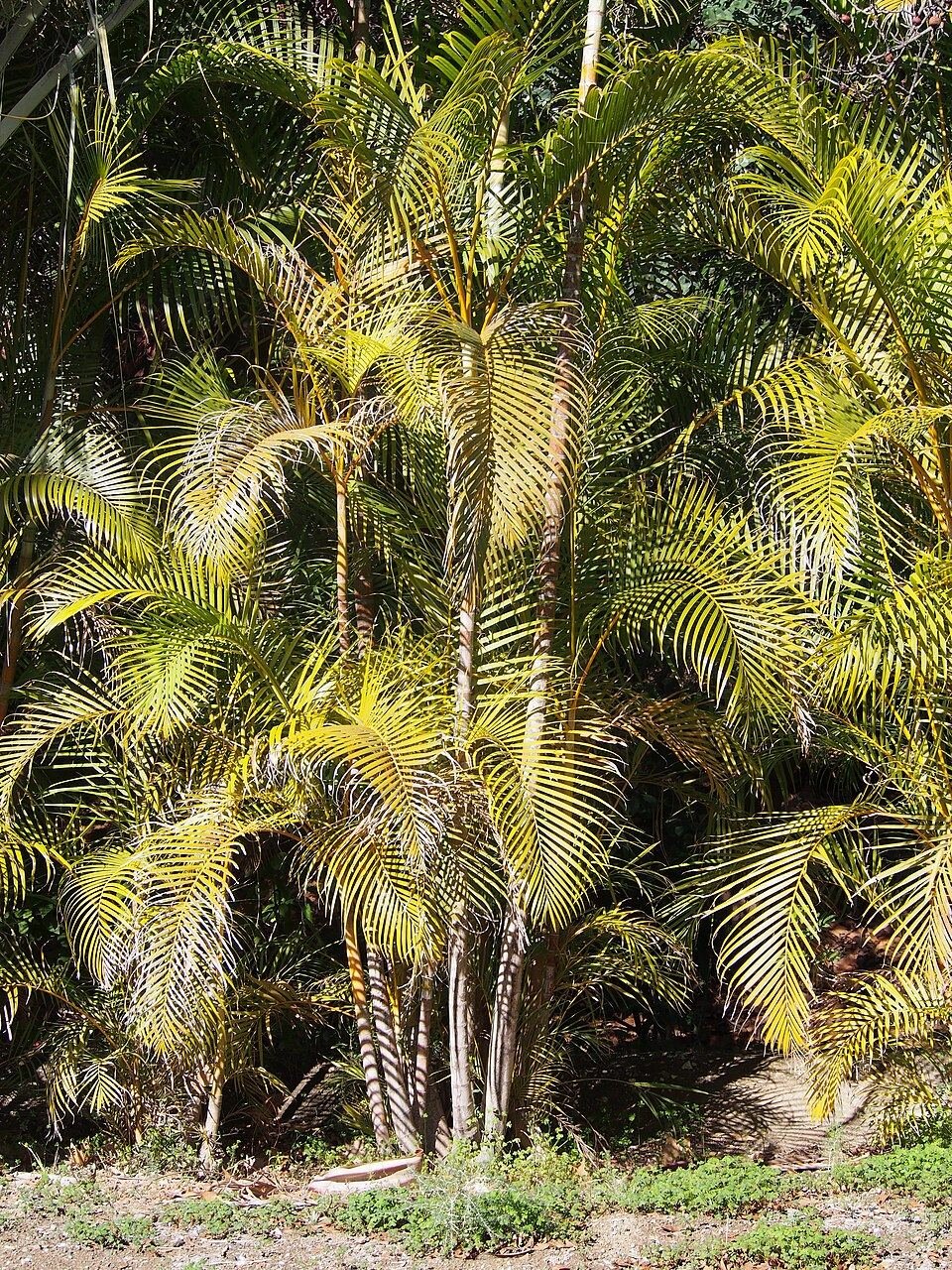
Areca palm overview
The clumping golden-cane palm of bright rooms and frost-free yards. Madagascar native, USDA 10a to 11, often sold as Dypsis lutescens.
Region of origin
Eastern Madagascar
Native countries
Historical discovery
Hermann Wendland published Chrysalidocarpus lutescens in 1878. For years nurseries sold it as Dypsis lutescens. Kew now places it back in Chrysalidocarpus.
Names
Common names
Areca palm, Butterfly palm, Golden cane palm, Yellow palm
Synonyms
- Dypsis lutescens (H.Wendl.) Beentje & J.Dransf.
- Chrysalidocarpus lutescens H.Wendl.
Cold hardiness
Survives about 30°F / -1°C. Outdoor range USDA 10a–11b. Hover or click a zone, state, or country. Switch the U.S. map between states and hardiness zones.
Highlighted USDA zones 10a–11b. Green countries can be grown outdoors.
United States
In range Too cold
World
Native Can be grown
Alaska and Hawaii are state outlines with their overall zone range. A country is painted if its mildest inhabited winter is at least one USDA step milder than this palm’s hardiness.
Scientific facts
- It is not the betel-nut tree Areca catechu. That is a different genus.
- Yellow-green canes and a clustering habit are the ID, not the nursery word areca.
- Indoors it wants bright light and even moisture. Brown tips are usually dry air or fluoride, not a mystery disease.
Get this palm
Other helpful resources
Full care guide
The areca palm is the clumping, yellow-stemmed palm in so many bright living rooms. Outdoors it is a frost-free landscape plant from Madagascar. Kew's accepted name is Chrysalidocarpus lutescens. Tags still say Dypsis lutescens. It is not Areca catechu, the betel-nut palm.
Common Names:
Areca palm, butterfly palm, golden cane palm, yellow palm.
Scientific Name:
Chrysalidocarpus lutescens H.Wendl. Widely sold as Dypsis lutescens.
Origin:
Eastern Madagascar.
Appearance:
A clustering feather palm with slender yellow-green canes and arching, pinnate fronds. New shoots keep coming from the base, so it forms a clump, not a single trunk.
Growth Rate:
Fast in heat with water. Moderate as a houseplant.
Max Growth Height:
Outdoors 15 to 30 feet in the tropics. Indoors a 6 to 8 foot clump is a large specimen.
Foliage Spread:
The clump can span 8 to 15 feet outside. Give it room, or keep dividing pots indoors.
Cold Hardiness and Hardiness Zone:
USDA 10a to 11 outdoors. Damage around 30°F (-1°C). Brief dips may burn foliage. It is a houseplant everywhere colder than that.
Soil Type:
Rich, moist, well-drained mix. Indoors, a peat-based potting mix with extra drainage works. Do not leave the pot in a saucer of water.
Fruit and Flowering:
Small yellow to black fruits on mature outdoor clumps. Indoor plants rarely fruit.
Can it Grow Indoors:
Yes. This is one of the standard indoor palms. It wants a bright room, not a dark corner.
Light Requirements:
Bright indirect light indoors. Morning sun is fine. Harsh afternoon glass-sun can bleach fronds. Outdoors: sun to light shade in the true tropics, afternoon shade in hot dry interiors.
Water Requirements:
Keep evenly moist. Let the top inch dry slightly, then water. Dry air and irregular watering brown the tips.
Maintenance Level:
Low to medium. Trim dead fronds at the cane. Feed in the growing season with palm-specific fertilizer. Indoors, rinse dust off the leaflets and watch the water quality. Fluoride and tap-salt build-up show as brown tips.
Common Diseases/Pests:
Spider mites in dry rooms, scale, and mealybugs. Check the undersides of leaflets. A weak, yellow clump in a dim room is usually light and water, not a rare disease.
Plant Care:
Give it bright light, even moisture, and drainage. Outdoors, plant only where winters stay above the high 20s. Indoors, rotate the pot so it does not lean toward the window.
Areca palm Frequently Asked Questions:
1. Is areca palm the same as betel nut?
No. Betel nut is Areca catechu. The houseplant areca is Chrysalidocarpus lutescens, still sold as Dypsis lutescens.
2. Can it live in a dark apartment?
Not well. It stretches and drops fronds. A parlor palm or kentia is the low-light choice. Areca wants a bright room.
3. Is it safe for pets?
Areca palm is generally treated as non-toxic, unlike sago, which is a cycad and poisonous. Still keep pets from chewing any houseplant.
4. Why are the tips brown?
Dry air, uneven watering, or salts in tap water. Check mites before you assume fertilizer will fix it.
If you want a full, feathery indoor clump, areca is the usual answer. Give it light and steady water. If your winters freeze, keep it in a pot and forget the backyard.