
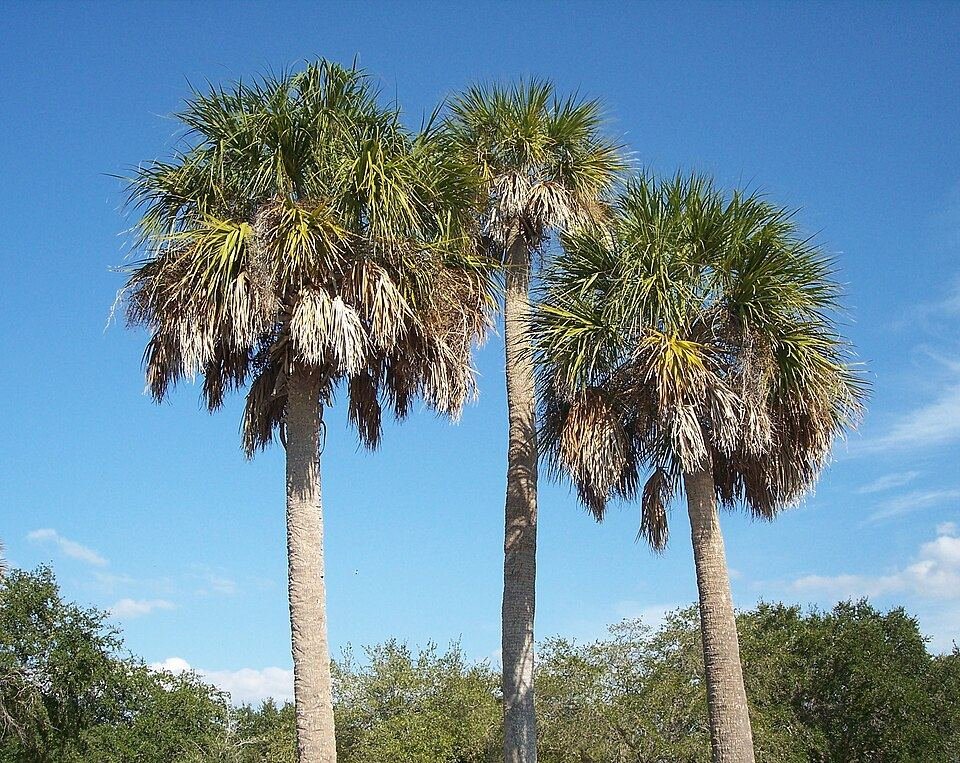
Cabbage palmetto overview
The native cabbage palmetto of the Southeast. USDA 8a to 11, costapalmate fans, and a much hardier street tree than royal or coconut.
Region of origin
Southeastern United States to western Cuba
Native countries
Historical discovery
Thomas Walter published Corypha palmetto in 1788. The current Sabal combination dates to 1830. It is the state tree of Florida and South Carolina.
Names
Common names
Cabbage palmetto, Cabbage palm, Sabal palm
Synonyms
- Corypha palmetto Walter
Cold hardiness
Survives about 15°F / -9°C. Outdoor range USDA 8a–11a. Hover or click a zone, state, or country. Switch the U.S. map between states and hardiness zones.
Highlighted USDA zones 8a–11a. Green countries can be grown outdoors.
United States
In range Too cold
World
Native Can be grown
Alaska and Hawaii are state outlines with their overall zone range. A country is painted if its mildest inhabited winter is at least one USDA step milder than this palm’s hardiness.
Scientific facts
- State tree of Florida and South Carolina.
- Costapalmate leaves: a fan with a midrib that extends into the blade.
- Boot jacks (old leaf bases) often stay on the trunk for years.
Get this palm
Other helpful resources
Full care guide
Cabbage palmetto is the native street palm of the southeastern coastal plain, not an import trying to look like Miami. USDA 8a to 11. It takes freezes that would finish a royal or coconut, and it is the state tree of Florida and South Carolina.
Common Names:
Cabbage palmetto, cabbage palm, sabal palm.
Scientific Name:
Sabal palmetto (Walter) Lodd. ex Schult. & Schult.f.
Origin:
Southeastern United States to western Cuba. Coastal plain, hammocks, and some inland sites.
Appearance:
A solitary palm with costapalmate fans (a palmate leaf with a midrib that runs into the blade), a variable skirt of old bases, and a gray trunk that may keep boot jacks for years.
Growth Rate:
Slow to moderate. Faster in frost-free south Florida than in zone 8b.
Max Growth Height:
Often 30 to 50 feet, taller on old coastal trees. Not a 100-foot Washingtonia.
Foliage Spread:
About 10 to 15 feet.
Cold Hardiness and Hardiness Zone:
USDA 8a to 11. Established trees take readings in the mid-teens F with damage, sometimes lower. It is a serious zone 8b and 9 landscape palm. Zone 7 is still needle palm and windmill country.
Soil Type:
Any well-drained soil, including sand and coastal fill. It handles brief flooding better than many feather palms, then wants to dry.
Fruit and Flowering:
Black fruit that wildlife eats. Seedlings show up in beds if birds sit above them.
Can it Grow Indoors:
No.
Light Requirements:
Full sun. Young plants take some shade.
Water Requirements:
Regular water to establish. Native sites range from moist to seasonally dry. Do not keep it in a sealed wet hole.
Maintenance Level:
Low to medium. You can leave boots or clean the trunk. Feed in the growing season with palm-specific fertilizer in sand. Hurricane-broken fans are a cleanup job.
Common Diseases/Pests:
Palmetto weevil on stressed or newly transplanted trees, scale, and occasional leaf disease in still shade. Plant healthy, water, and do not butcher the crown.
Plant Care:
Plant in sun with drainage. Water the first year. Use this when you want a native Southeast palm, not a coconut in a climate that still freezes.
Cabbage palmetto Frequently Asked Questions:
1. Is cabbage palm the same as palmetto?
Cabbage palmetto is Sabal palmetto, a tree. Saw palmetto is Serenoa, a shrub. People say palmetto for both.
2. Can I grow it in Atlanta or Dallas?
Dallas has used it in warm sites. Atlanta is the cold edge. A hard zone 7 winter is a risk. Windmill and needle palm are safer there.
3. Why did a newly planted sabal die?
Weevil on a stressed transplant is a classic. Plant in the warm season, water, and do not overprune the head.
4. Does it grow fast?
Not like a queen palm. Budget years, not months, for a trunk.
If you garden on the southeastern coastal plain, cabbage palmetto is the native tree palm to learn first. Save royals and coconuts for the places that never freeze.