
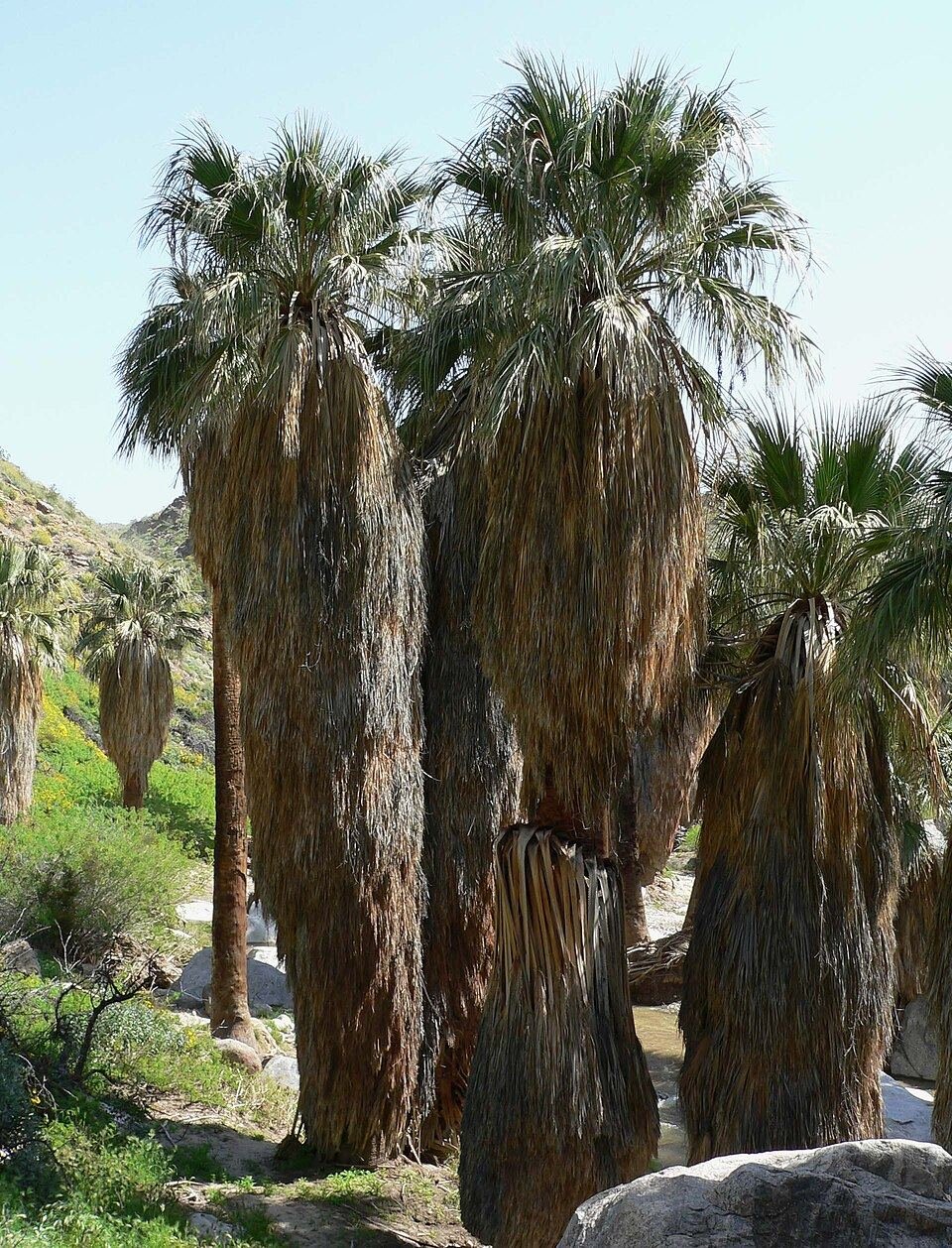
California fan palm overview
The stout desert fan palm native to California and Arizona oases. USDA 8b to 11, hardier and thicker-trunked than the Mexican fan.
Region of origin
Southern California to Arizona and northwest Mexico
Native countries
Historical discovery
Thomas Moore and Maxwell Masters published Pritchardia filifera in 1876. Wendland placed it in Washingtonia. It is the only palm native to the western United States.
Names
Common names
California fan palm, Desert fan palm, Cotton palm
Synonyms
- Pritchardia filifera T.Moore & Mast.
Cold hardiness
Survives about 18°F / -8°C. Outdoor range USDA 8b–11a. Hover or click a zone, state, or country. Switch the U.S. map between states and hardiness zones.
Highlighted USDA zones 8b–11a. Green countries can be grown outdoors.
United States
In range Too cold
World
Native Can be grown
Alaska and Hawaii are state outlines with their overall zone range. A country is painted if its mildest inhabited winter is at least one USDA step milder than this palm’s hardiness.
Scientific facts
- Native oasis palm of the Colorado Desert, not a tropical import.
- Threads on the leaf segments give the filifera name.
- Thicker trunk and shorter ultimate height than Mexican fan palm.
Get this palm
Other helpful resources
Full care guide
The California fan palm is the stout oasis palm of the western deserts, and the only palm native to the western United States. USDA 8b to 11. It is thicker, a bit hardier, and usually shorter at maturity than the Mexican fan palm that cities plant as a skyduster.
Common Names:
California fan palm, desert fan palm, cotton palm.
Scientific Name:
Washingtonia filifera (T.Moore & Mast.) H.Wendl. ex de Bary.
Origin:
Southern California to Arizona and northwest Mexico, in desert oases and canyon seeps.
Appearance:
A fan palm with a thick trunk, a full skirt unless trimmed, and palmate leaves with thread-like fibers between the segments. Compare the skinny Mexican fan, which is a Baja plant.
Growth Rate:
Moderate, faster with irrigation in heat.
Max Growth Height:
Often 40 to 60 feet, sometimes taller. Not the 100-foot street pole of robusta.
Foliage Spread:
About 12 to 15 feet.
Cold Hardiness and Hardiness Zone:
USDA 8b to 11. Damage around 18°F (-8°C) on established trees, with variation. It is one of the better big fan palms for the cold edge of the desert. Zone 7 is still windmill country.
Soil Type:
Any well-drained soil. Native sites are often alkaline and sandy or gravelly, with water at depth.
Fruit and Flowering:
Small black fruit. Coyotes and birds eat them in native groves. Seedlings appear in irrigated urban soil.
Can it Grow Indoors:
No.
Light Requirements:
Full sun.
Water Requirements:
Oasis logic: dry air, water at the roots. Deep water in heat. It is not a cactus. Do not plant it in a sealed clay bowl.
Maintenance Level:
Medium. Skirts are habitat and fire fuel. Feed in the growing season with palm-specific fertilizer if you irrigate heavily in sand.
Common Diseases/Pests:
Scale, weevils on stressed trees, and the same Washingtonia wilt concerns as Mexican fan in some California towns. Keep pruning tools clean.
Plant Care:
Full sun, drainage, occasional deep water. Choose filifera when you want the native desert fan, not the skinny Baja skyduster.
California fan palm Frequently Asked Questions:
1. Is this the palm in Palm Springs?
Yes. Native California fan palms form the oasis groves of that desert.
2. Hardier than Mexican fan?
Usually, yes, and the trunk is thicker. Mexican fan still wins if you only want height fast.
3. Can I grow it in Texas or the Southeast?
In warm, drained sites, yes as a landscape fan. Humid summers are not its native climate, but it is widely planted.
4. Do I have to keep the skirt?
No. Wild groves keep thatch. Cities often trim. Fire and rats are the usual reasons to cut.
If you want the western native fan palm, this is the one. Plant it in sun with water at the roots, and do not confuse it with the skinny Mexican skyduster.