
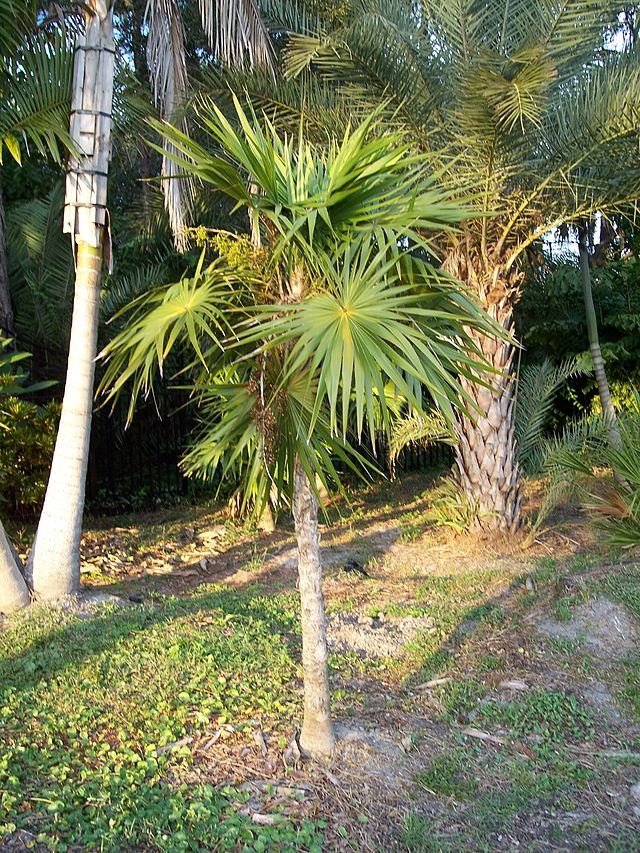
Florida thatch palm overview
The native south Florida thatch. USDA 10a to 11, a slim fan for Keys and coastal limestone, not a cabbage palmetto and not a coconut.
Region of origin
South Florida, the Caribbean, and adjacent Mexico to Nicaragua
Native countries
Historical discovery
Loddiges material was published by Schultes and Schultes f. in 1830. It is a native south Florida thatch palm, split from Key thatch (Leucothrinax morrisii).
Names
Common names
Florida thatch palm, Silk-top thatch palm, Thatch palm
Synonyms
- None widely used
Cold hardiness
Survives about 28°F / -2°C. Outdoor range USDA 10a–11b. Hover or click a zone, state, or country. Switch the U.S. map between states and hardiness zones.
Highlighted USDA zones 10a–11b. Green countries can be grown outdoors.
United States
In range Too cold
World
Native Can be grown
Alaska and Hawaii are state outlines with their overall zone range. A country is painted if its mildest inhabited winter is at least one USDA step milder than this palm’s hardiness.
Scientific facts
- Native in south Florida and the Caribbean.
- Key thatch is Leucothrinax morrisii, usually smaller, with different leaf bases.
- Salt-tolerant compared with many feather palms.
Get this palm
Other helpful resources
Full care guide
Florida thatch palm is Thrinax radiata, a native slim fan of the Keys, south Florida coasts, and the Caribbean. USDA 10a to 11. It is not cabbage palmetto and not coconut. Limestone, salt air, and sun are the natural setting.
Common Names:
Florida thatch palm, silk-top thatch, thatch palm. Key thatch is Leucothrinax morrisii.
Scientific Name:
Thrinax radiata Lodd. ex Schult. & Schult.f.
Origin:
South Florida, the Caribbean, and adjacent Mexico to Nicaragua, often on coastal limestone.
Appearance:
A slender, pale trunk and palmate fans, often with a split hastula look and light undersides. Smaller and cleaner than sabal.
Growth Rate:
Slow to moderate.
Max Growth Height:
Often 15 to 25 feet, sometimes to 30.
Foliage Spread:
About 8 to 12 feet.
Cold Hardiness and Hardiness Zone:
USDA 10a to 11. Damage around 28°F (-2°C). Not a central-Florida cabbage palmetto substitute.
Soil Type:
Well-drained, including sand and limestone. Wet acidic clay is a poor match.
Fruit and Flowering:
Small white fruit on mature trees.
Can it Grow Indoors:
No.
Light Requirements:
Full sun. It takes some light shade.
Water Requirements:
Regular water to establish. Mature coastal plants take short dry spells.
Maintenance Level:
Low. Feed in the growing season with palm-specific fertilizer in sand. Do not overprune the head.
Common Diseases/Pests:
Scale and weevils on stressed transplants. Salt is less of a problem than on a queen palm.
Plant Care:
Sun, drainage, south Florida or similar. Use this when you want a native thatch, not a coconut. Use cabbage palmetto farther north on the coastal plain.
Florida thatch palm Frequently Asked Questions:
1. Florida thatch or Key thatch?
Florida thatch is Thrinax radiata. Key thatch is Leucothrinax morrisii, usually smaller, with a different leaf-base split.
2. Thatch or silver palm?
Silver palm is Coccothrinax argentata, with a more silver leaf underside and a different trunk.
3. Can I grow it in Orlando?
Orlando is the cold edge. South Florida and the Keys are the comfortable range.
4. Is it salt tolerant?
Yes, for a native coastal fan. Still water it while it establishes.
Plant Florida thatch on south Florida limestone and similar coasts when you want the native slim fan. Farther north, cabbage palmetto is the sabal that still makes sense.