
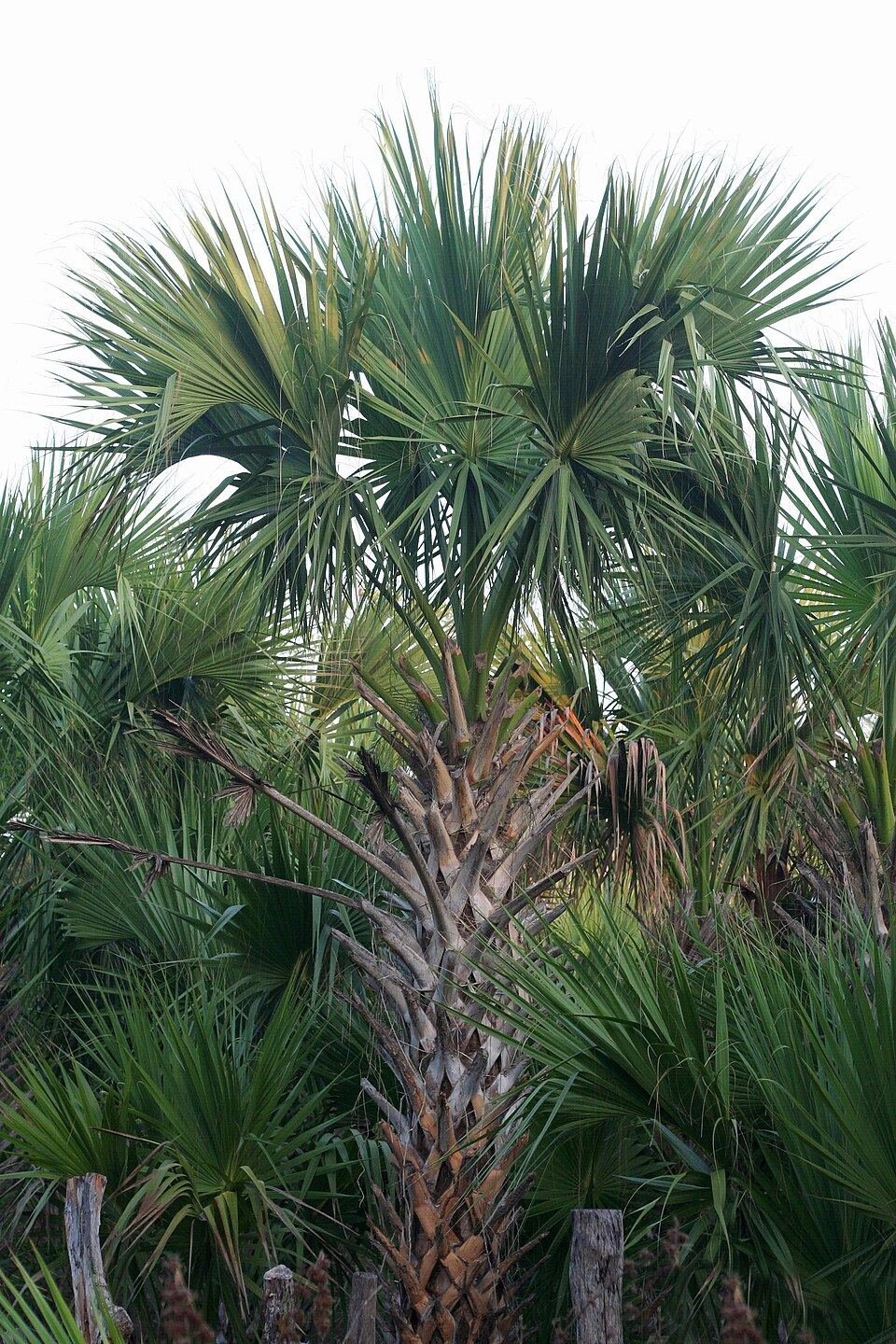
Texas palmetto overview
The native tree palmetto of south Texas. USDA 8b to 11, thicker than cabbage palmetto, and a Rio Grande plant rather than a Carolina coastal one.
Region of origin
Southern Texas to Costa Rica
Native countries
Historical discovery
Carl Martius published Sabal mexicana in 1838. It is the native tree palmetto of the Rio Grande country, heavier than cabbage palmetto.
Names
Common names
Texas palmetto, Mexican palmetto, Texas sabal
Synonyms
- Sabal texana (Cook) Becc.
Cold hardiness
Survives about 15°F / -9°C. Outdoor range USDA 8b–11a. Hover or click a zone, state, or country. Switch the U.S. map between states and hardiness zones.
Highlighted USDA zones 8b–11a. Green countries can be grown outdoors.
United States
In range Too cold
World
Native Can be grown
Alaska and Hawaii are state outlines with their overall zone range. A country is painted if its mildest inhabited winter is at least one USDA step milder than this palm’s hardiness.
Scientific facts
- Often sold as Sabal texana, a name still on older tags.
- Heavier trunk and larger fans than Sabal palmetto.
- Native in the Lower Rio Grande Valley, not a tropical import.
Get this palm
Other helpful resources
Full care guide
Texas palmetto is the native tree sabal of the Rio Grande country and south into Mexico and Central America. USDA 8b to 11. It is thicker and often a little more massive than cabbage palmetto. Older tags say Sabal texana.
Common Names:
Texas palmetto, Mexican palmetto, Texas sabal.
Scientific Name:
Sabal mexicana Mart. Sabal texana is the old garden name.
Origin:
Southern Texas to Costa Rica, river bottoms and coastal plain.
Appearance:
A stout sabal with large costapalmate fans and a heavy gray trunk. Boots may persist. It reads as a bigger, thicker cabbage palmetto.
Growth Rate:
Slow to moderate.
Max Growth Height:
Often 30 to 50 feet.
Foliage Spread:
12 to 18 feet.
Cold Hardiness and Hardiness Zone:
USDA 8b to 11. Established trees take the mid-teens F with damage, sometimes lower. Cabbage palmetto is the Carolina and Florida coastal cousin. Dwarf palmetto is the shrub.
Soil Type:
Any well-drained soil, including alkaline Texas fill. Water to establish.
Fruit and Flowering:
Black fruit. Wildlife eats it.
Can it Grow Indoors:
No.
Light Requirements:
Full sun.
Water Requirements:
Regular water the first years. Mature trees take heat and short drought better than a queen palm.
Maintenance Level:
Low to medium. You can leave boots or clean the trunk. Feed in the growing season with palm-specific fertilizer in sand.
Common Diseases/Pests:
Palmetto weevil on stressed transplants, scale. Plant healthy and do not butcher the crown.
Plant Care:
Sun, drainage, patience. Use this when you want a native south Texas tree palm. Use dwarf palmetto when you want a shrub. Use cabbage palmetto on the Atlantic coastal plain.
Texas palmetto Frequently Asked Questions:
1. Texas palmetto or cabbage palmetto?
Texas palmetto is Sabal mexicana, native on the Rio Grande side. Cabbage palmetto is S. palmetto, the Florida and Carolina state tree.
2. Is Sabal texana a different species?
It is the old name for this one. Kew treats mexicana as the species.
3. Can I grow it in Austin or San Antonio?
Warm sites in 8b and 9 are the conversation. A hard freeze still burns. Plant established, water, and do not expect coconut.
4. Does it grow fast?
No. Budget years for a trunk.
If you garden in south Texas and want the native tree palmetto, this is Sabal mexicana. If you wanted a low clump, you wanted dwarf palmetto.