Outdoor verdict
Caranday wax palm lives outside where winter stays above about 18F (USDA 8b+). If your winter drops below that, skip it. Do not wrap a tropical and hope.
A tough fan palm of South American wetlands and savannas, coated in useful wax and hardier than most tropical Copernicia.
Cold hardiness
Survives about 18°F / -8°C. Outdoor range USDA 8b–11a. Hover or click a zone, state, or country. Click a state to open palms that grow there.
Highlighted USDA zones 8b–11a. Green countries can be grown outdoors.
United States
In range Too cold
World
Native Can be grown
Alaska and Hawaii are state outlines with their overall zone range. A country is painted if its mildest inhabited winter is at least one USDA step milder than this palm’s hardiness.
Winter care
Drainage matters more than a blanket. Soil: Any well-drained soil. Water: Moist but never waterlogged (mesic). Wrapping does not buy an extra zone. If the winter is colder than the kill number, keep it in a pot.
Scientific facts
- Leaf wax has been used like carnauba (from Copernicia prunifera).
- Stands flooding better than many landscape palms.
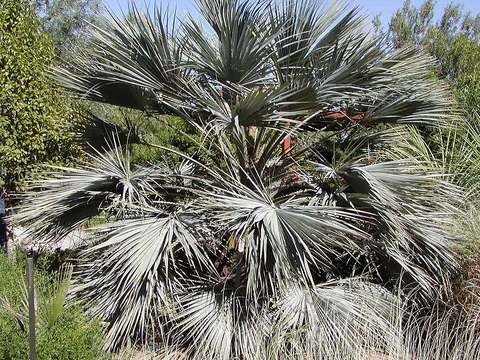
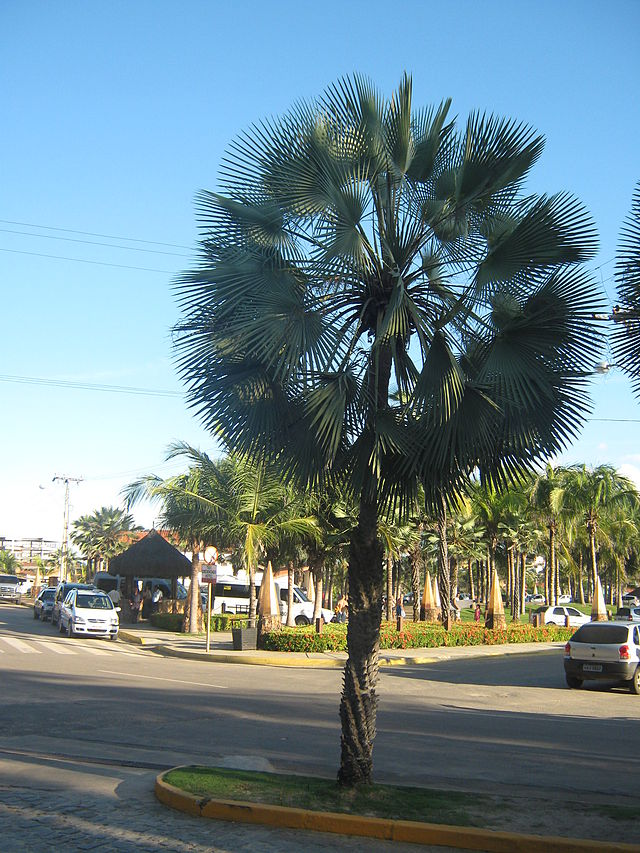
- Blue-gray costapalmate leaves look almost metallic in sun.
Region of origin
Brazil to northeastern Argentina
Native countries
Historical discovery
Thomas Morong published Copernicia alba in 1893 from the Paraná basin. The genus honors Nicolaus Copernicus; alba refers to the pale wax on the leaves.
Names
Common names
Caranday, Caranday wax palm, Caraná
Synonyms
- Copernicia australis Becc.
Full care guide
The Caranday palm is a rare palm not well studied or cultivated. It’s characterized by bulbous foliage composed of wide spreading palm leaves. The Caranday Wax palm thrives within USDA hardiness zones 9 to 11.
Growth Rate:
Slow to moderate. This palm can grow by around 1 foot per year.
Maximum Growth Height:
The Caranday Palm can grow up to 60-80 feet tall.
Cold Hardiness and Hardy Zones:
The Caranday Wax palm is a relatively cold hardy palm tree able to withstand temperatures down to 20 degrees Fahrenheit (-6 C). The Caranday wax palm can be grown in USDA hardiness zones 9-11.
Soil Preferences:
Well-draining soil. Caranday Palms flourish in various soil types with adequate drainage.
Fruits and Blooms:
The Caranday wax palm produces small creamy-white flowers that grow near the base of its leaves. These can produce small yellow fruits that ripen into a black color when ready to eat. Caranday wax palm fruit is characterized by an initial sweetness followed by a bitter aftertaste.
Suitable for Indoor Growth:
Not particularly suitable for indoor growth as it does like to grow to tall heights later in maturity.
Light Prerequisites:
Thrives in partial shade to full sun for optimal development.
Watering Needs:
Low to moderate watering. The Caranday Palm benefits from consistent watering during propagation, but once established this palm is quite drought tolerant.
Maintenance Level:
Low maintenance. These palms benefit from regular watering and occasional fertilization.
Common Issues with Caranday Palms
Frequent Diseases/Pests:
Generally resilient, Caranday Palms may encounter spider mites or mealybugs like other palm varieties.
Solution:
Apply sprayable pesticidal horticulture oil.
Plant Care:
Maintain a consistent watering routine and apply high quality palm-specific fertilizer 2-3 times annually during the growing season for optimal growth.
The Caranday Wax palm, though a rare variety, is a beautiful tropical addition to anyone’s landscape. If you can manage to find a seller in your area maybe you can be the owner of one of these remarkable palm trees.
Caranday wax palm questions
Will Caranday wax palm live outside?
Yes, if winter stays above about 18F (USDA 8b+). Below that number it belongs in a pot.
What do nurseries mislabel Caranday wax palm as?
Common names wander. The accepted name is Copernicia alba. Read the Latin on the tag before you buy.
Pot or ground for Caranday wax palm in a cold state?
Ground where winter stays above about 18F. A pot does not make a cold-tender palm hardy. Skip it if the number fails.
Do Caranday wax palms produce edible fruit?
The fruits are not known to be edible for humans and are not commonly consumed.
Are Caranday Wax palms drought resistant?
Yes, these palms are quite drought resistant once matured.
Is this an easily acquired variety of palm?
No, the Caranday Palm is not commonly sold and will be hard to find seeds or young plants unless you live in the native area of South America.
Related palms
The mix-up, the substitute, then nearby hardiness.