Outdoor verdict
Royal palm lives outside only in a mild winter, about 28F (USDA 10a+). A real freeze marks it. If your winter drops below that, skip it. Do not wrap a tropical and hope.
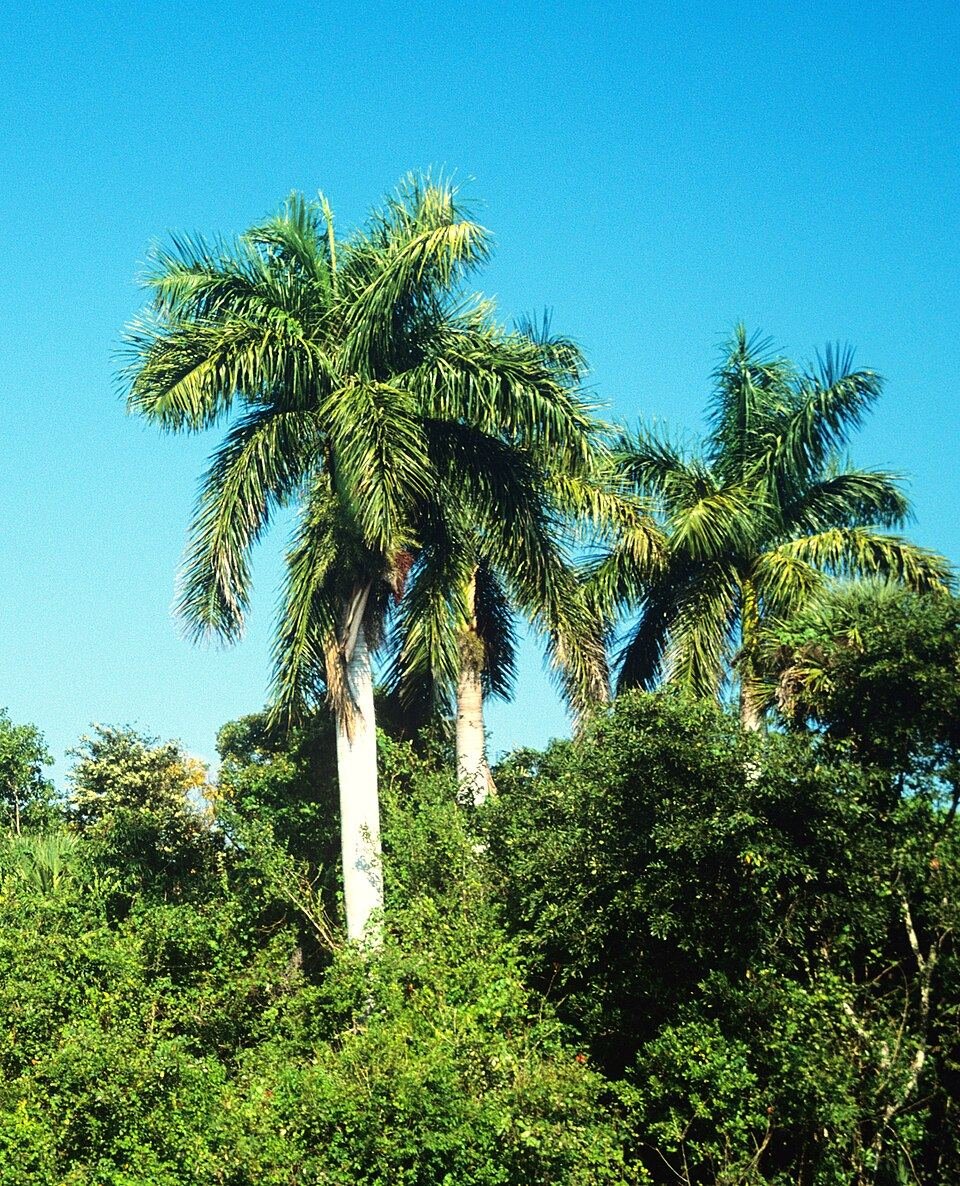
The smooth, cement-gray boulevard palm of south Florida. Native there and through the Caribbean, USDA 10a to 11, damage around 28°F.
Cold hardiness
Survives about 28°F / -2°C. Outdoor range USDA 10a–11b. Hover or click a zone, state, or country. Click a state to open palms that grow there.
Highlighted USDA zones 10a–11b. Green countries can be grown outdoors.
United States
In range Too cold
World
Native Can be grown
Alaska and Hawaii are state outlines with their overall zone range. A country is painted if its mildest inhabited winter is at least one USDA step milder than this palm’s hardiness.
Winter care
Drainage matters more than a blanket. Soil: Any well-drained soil. Water: Moist but never waterlogged (mesic). Wrapping does not buy an extra zone. If the winter is colder than the kill number, keep it in a pot.
Scientific facts
- The green crownshaft and smooth gray trunk are the ID from a moving car.
- It is native in parts of south Florida, not a purely exotic import.
- Hurricane wind can defoliate it. The bud often pushes again if the spear is not rotten.
Region of origin
South Florida, Mexico to Central America, and the Caribbean
Native countries
Historical discovery
Kunth published Oreodoxa regia in 1816. O.F. Cook moved it to Roystonea in 1900, honoring General Roy Stone.
Names
Common names
Royal palm, Cuban royal palm, Florida royal palm
Synonyms
- Oreodoxa regia Kunth
Full care guide
The royal palm is the smooth, cement-gray boulevard tree of south Florida and the Caribbean. Native in parts of Florida, Mexico, Central America, and the islands. USDA 10a to 11. A freeze around 28°F (-2°C) burns the crown. It wants heat, water, and a wide street, not a zone 9 patio.
Growth Rate:
Fast in heat with water and fertilizer. Slow in a cool winter or a tight tree pit.
Fruit and Flowering:
Purple-black fruit that birds and bats eat. Messy on cars parked under a row.
Light Requirements:
Full sun.
Water Requirements:
Regular water, especially in sand and in the first years. Do not let a new royal dry into a crispy spear.
Maintenance Level:
Medium. Self-cleaning most of the time, but a dropped frond is heavy. Feed in the growing season with palm-specific fertilizer. Potassium hunger shows as translucent spotting and leaflet-tip death.
Common Diseases/Pests:
Ganoderma on old trunks, lethal yellowing in some regions, scale, and weevils on stressed trees. A rotten spear after a hurricane is a sanitation job, not a mystery.
Plant Care:
Plant in full sun with irrigation in sand. Keep it off small lots. Fertilize. Do not expect it to replace a windmill in a freeze-prone yard.
Royal palm Frequently Asked Questions:
Plant a royal palm on a warm, irrigated street in zone 10 or 11. If your winter still freezes, pick a different silhouette.
Royal palm questions
Will Royal palm live outside?
Yes, if winter stays above about 28F (USDA 10a+). Below that number it belongs in a pot.
What do nurseries mislabel Royal palm as?
Common names wander. The accepted name is Roystonea regia. Read the Latin on the tag before you buy.
Pot or ground for Royal palm in a cold state?
Ground where winter stays above about 28F. A pot does not make a cold-tender palm hardy. Skip it if the number fails.
Is royal palm native to Florida?
Yes, in parts of the south. It is also native more widely in the Caribbean basin.
Can I grow it in Orlando or Tampa?
Those climates sit on the cold edge. A hard freeze will burn or kill it. South Florida is the comfortable range.
Royal vs queen palm?
Royal is smoother, with a green crownshaft, and wants more heat. Queen is plumose, messier with orange fruit, and a little more forgiving in 9a.
How fast does it grow?
Fast in heat with water and fertilizer. It is a boulevard tree, not a slow indoor palm.
Related palms
The mix-up, the substitute, then nearby hardiness.