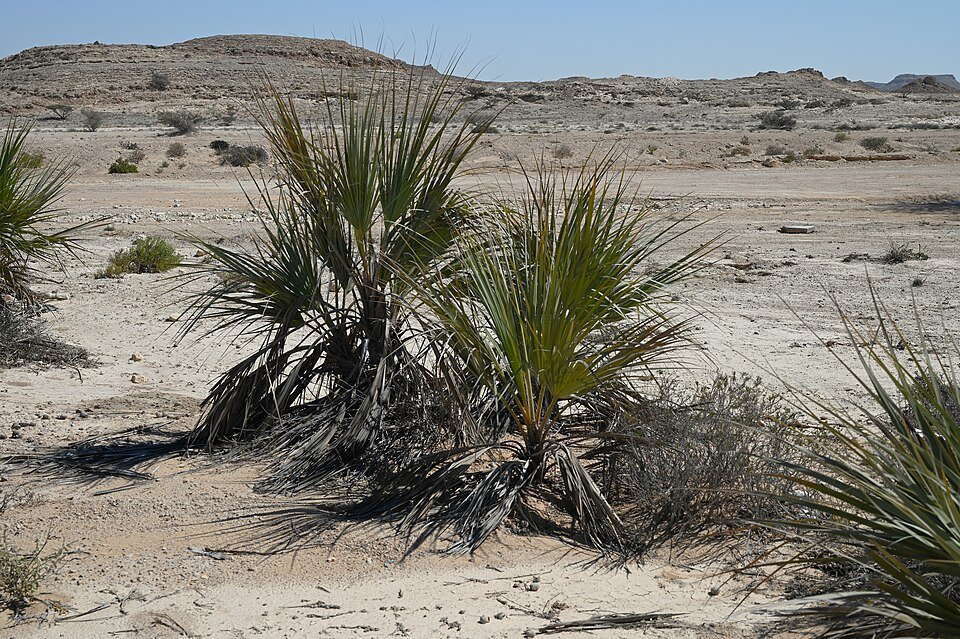
Outdoor verdict
Mazari palm lives outside where winter stays above about 10F (USDA 8a+). If your winter drops below that, skip it. Do not wrap a tropical and hope.
The branching desert fan. USDA 8a to 11 in dry climates, about 10F, and a poor match for a wet zone 7.
Cold hardiness
Survives about 10°F / -12°C. Outdoor range USDA 8a–11a. Hover or click a zone, state, or country. Click a state to open palms that grow there.
Highlighted USDA zones 8a–11a. Green countries can be grown outdoors.
United States
In range Too cold
World
Native Can be grown
Alaska and Hawaii are state outlines with their overall zone range. A country is painted if its mildest inhabited winter is at least one USDA step milder than this palm’s hardiness.
Winter care
Drainage matters more than a blanket. Soil: Any well-drained soil. Water: Low water once established (xeric). A young plant sees more damage than an old one. Wrap only when a night near the kill number is coming.
Scientific facts
- Almost unique among palms for branching. Stems split. Each stem flowers once and dies. The clump keeps going.
- Dry cold is the trick. Wet winters rot it. Needle palm is the wet-cold answer, not this one.
- Nurseries write Nannorrhops ritchiana. Kew accepts Nannorrhops ritchieana. Same plant.
Region of origin
Southern Arabian Peninsula, Iran, Afghanistan, and Pakistan
Native countries
Historical discovery
William Griffith published Chamaerops ritchieana. James Edward Tierney Aitchison moved it to Nannorrhops in 1882. Kew keeps the ie spelling, ritchieana.
Names
Common names
Mazari palm, Mazari fan palm, Dwarf Mazari
Synonyms
- Chamaerops ritchieana Griff.
- Nannorrhops ritchiana (hort. spelling)
Full care guide
The Mazari palm is the branching desert fan people plant when they want a hardy palm in dry cold. It is Nannorrhops ritchieana. USDA 8a to 11 if the winter stays dry. A wet zone 7 kills it with rot, not with frost.
Growth Rate:
Slow, especially in cool or wet soil. Heat and a dry root run speed it up. Still not a queen palm.
Fruit and Flowering:
Each stem is monocarpic: it flowers, fruits, then dies. The clump lives on. Small fruit, not a kitchen crop. Kew also accepts Nannorrhops baluchestanica as a separate species from southeastern Iran.
Light Requirements:
Full sun. Shade makes a thin, green, unhappy plant.
Water Requirements:
Water to establish. Then treat it like a desert plant. Extra summer water is fine if drainage is fast. Do not keep it soggy in winter.
Maintenance Level:
Low once the drainage is right. Feed in the growing season with palm-specific fertilizer in heat. Leave the branching habit. Do not keep the crown packed with wet mulch.
Common Diseases/Pests:
Root and crown rot in wet cold. Scale and nutrient yellowing in sand. Seedlings rot if you water them like an areca. Lethal yellowing is reported on some plantings. Buy clean stock.
Plant Care:
Full sun, sharp drainage, dry winter. Use it in the desert Southwest, interior California, and other dry-summer climates. If a Mexican blue palm already looks miserable in your humidity, skip this too.
Mazari palm Frequently Asked Questions:
Plant Mazari palm where you wanted a hardy fan and your winter is dry. If the ground stays wet from November to March, buy a needle palm instead.
Mazari palm questions
Will Mazari palm live outside?
Yes, if winter stays above about 10F (USDA 8a+). Below that number it belongs in a pot.
What do nurseries mislabel Mazari palm as?
Common names wander. The accepted name is Nannorrhops ritchieana. Read the Latin on the tag before you buy.
Pot or ground for Mazari palm in a cold state?
Ground where winter stays above about 10F. A pot does not make a cold-tender palm hardy. Skip it if the number fails.
Why do some tags say ritchiana and Kew says ritchieana?
Same species. Kew accepts Nannorrhops ritchieana. The missing e is a long-running horticultural spelling.
Does Mazari palm really branch?
Yes. That is the odd trick. Stems can fork. Each stem flowers once and dies. The clump continues. Most palms never do this.
Will it like Arizona, Georgia, or the Pacific Northwest?
Arizona and other dry-winter deserts are the fit, with drainage. Georgia humidity and a PNW wet winter are a poor match even when the USDA number looks right. Match climate, not just zone.
Related palms
The mix-up, the substitute, then nearby hardiness.